
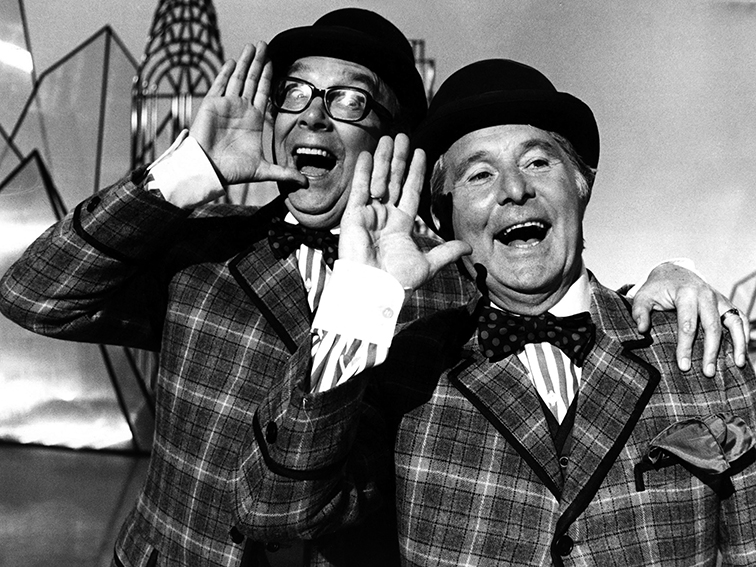
The canon is cruel, and we will celebrate many more centenaries than bicentenaries, but there is still a particular melancholy in watching fame fade. Eric Morecambe would have turned 100 this month, which makes him almost exactly the same age as David Attenborough. And while the latter received a week-long Pompeian triumph – clapped by royalty in the Albert Hall, with Kirsty Young welling up while reading from the autocue, the whole ordeal live blogged by the BBC – Morecambe’s birthday was marked by one solitary listing: the rebroadcast of a “lost” episode The Morecambe and Wise Show from 16 September 1968. With his partner, Ernie Wise, Morecambe once performed to audiences of 20 million. Now, I think anyone under 50 would struggle to pick him out of a crowd of commuters (male-pattern baldness, thick specs – Sixties showbiz was so much more forgiving). And so, having skirted the gorilla whisperer’s jubilee, I tuned in to this lesser son of the golden age of broadcasting, to see a little of what it was like.
It opens simply – Eric and Ern’s faces popping up in different expressions as the credits roll, and the guest music acts announced (Trio Athénée and the Paper Dolls, both of whom the canon has treated even more harshly than Morecambe). The two stars then stroll on stage, in their jaunty suits, and basically just bicker for ten minutes. It is nice to be reminded how fundamentally silly television used to be. “Who came on then?” Eric asks, just after walking into view. “We did,” replies Ernie. “Oh!” hoots Eric. I’m vaguely aware that Ernie generally played the exasperated straight man to Eric’s fool. And things continue much like this, dramatised by the thin conceit of Eric giving Ernie very unhelpful directions to Harpenden. The conversation trips and stumbles through various comic mishearings and easy puns, and I’m not sure if it would be that funny if it weren’t for Eric Morecambe’s amazing, vibrating presence, grinning to the audience, scrunching his nose, frowning, jerking, squinting, fiddling and giggling.
Then it’s the musical stars – the Paper Dolls and Trio Athénée, together at last! They do their thing very handsomely: the Dolls being a three-piece girl group who look very Sixties, their hair rollered into conical beehives, and the trio being three pretty French boys with acoustic guitars. But then we’re straight back to Eric and Ern, who are fondly remembering a holiday they took at a nudist colony, and particularly Pauline, its much admired “manageress”. “I never realised I could enjoy myself so much without laughing,” says Morecambe, which makes me wonder if Woody Allen cribbed that line for Annie Hall.
We then segue into a sketch depicting the holiday itself, which is mostly Ernie trying to persuade Eric to get undressed (first he keeps his tie on, and insists on retaining his cloth cap). They are then joined by Pauline, and the relevant portions of the cast, it should be said, are shielded by a well positioned hedgerow. There is a slightly demeaning, grid-girl tone to this, especially when Pauline is joined by several other ladies, and when the show concludes with a “stripper” (this time shielded by three balloons). But the lascivious cheek is pretty much the only thing that dates the show – aside, that is, from the mentions of Jimmy Clitheroe, pease pudding, and “faggots”, the last an anachronism not of social attitudes but of the mid-century Midlands diet.

A full biopic deserves to be made about Eric Morecambe – the BBC’s dramatisation Eric and Ernie only covered the duo’s early career. There’s a tragic undercurrent to his life: he suffered his third heart attack immediately after walking offstage in Tewkesbury, having made six curtain calls. It’s the sort of role you can imagine Steve Coogan and Michael Sheen duking over, and perhaps that will give Morecambe his afterlife. But what strikes you watching Morecambe and Wise is just how cheerfully throwaway it is, so happy to amuse and not to matter. In Jonathan Coe’s 2001 novel The Rotters’ Club, he makes a big and mawkish deal of the pair and their ability to create a national “oneness”, “the entire nation… briefly, figuratively drawn together in the divine act of laughter”. Hearing the studio audience 58 years later, I know a little better what he means.
[Further reading: Ian McKellen thrills in The Christophers]
Content from our partners



Related
This article appears in the 20 May 2026 issue of the New Statesman, Definitely, maybe
Join the debate
Subscribe here to comment